Introduction
Welcome to my fourth and final work term report! This placement has been truly unique, but I have had such a great time and learned a bunch. I also got to meet and interact (virtually 😄) with some really great people. Throughout this report I will talk about the company I had my placement with, some goals I set for myself, and what the overall experience was like. I hope you enjoy, and for any other information feel free to contact me!
Employer Information
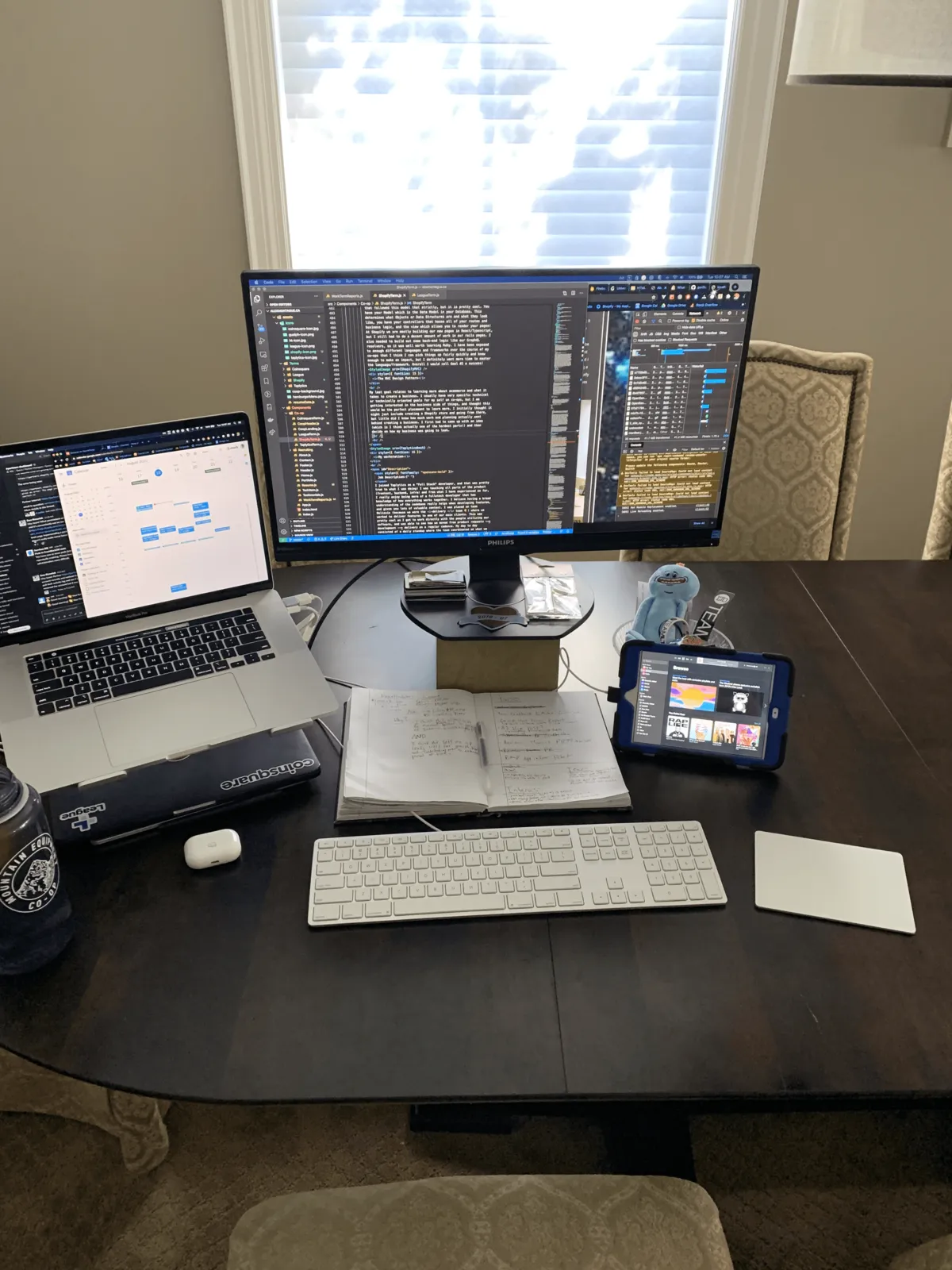
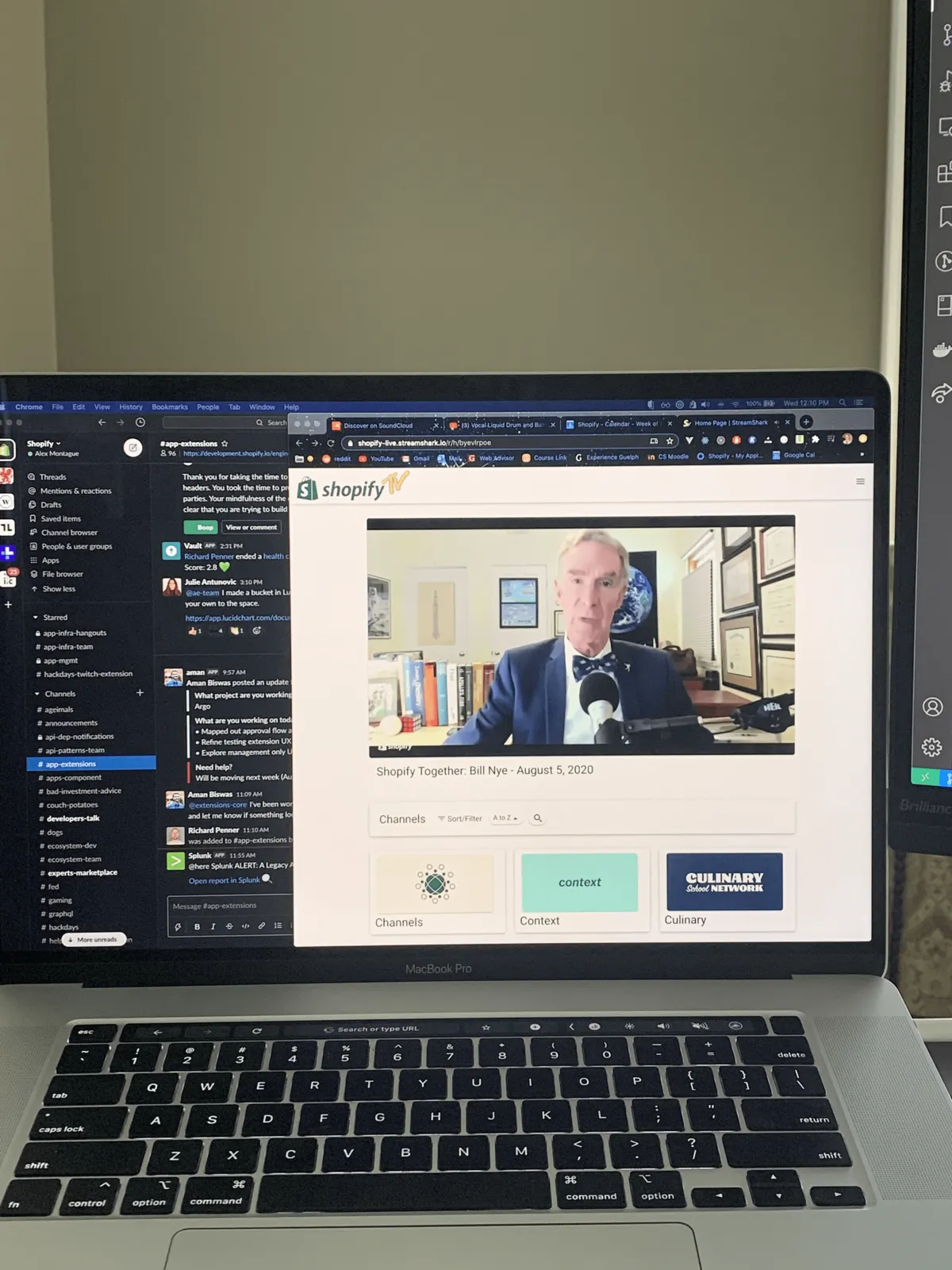
For this placement I was going to be located in the Shopify Toronto office, an area I have become very familiar with these past co-op placements, but ended up working entirely remote from my home in Oakville. I joined Shopify as a Web Developer, for a short but absolutely rewarding 4 month term. This was my first time working at a company that people have actually heard the name of before (even if it was confused with Spotify lol), and the sheer scale at which we operated really surprised me. Shopify is a commerce platform that allows anyone to set up an online store and sell their products. Merchants (the people who sell things and own the stores) can also sell their products in person with Shopify Point of Sale. Basically, Shopify enables anyone and everyone to create an ecommerce business, and start selling things they are passionate about. Shopify lets you set up your store, inventory, website and marketing all through an easy to use platform. Shopify also has a rich ecosystem of applications and add-ons that Merchants can use to level up their stores, and this was also the area my team operated in. Shopify was founded in 2004 by Tobias Lütke when he wanted to sell snowboards with his company at that time called Snowdevil. He quickly realized it was incredibly challenging to sell snowboards online without an easy to use ecommerce platform, so he decided to create one himself and Shopify was born. This has really been one of the most exciting placements so far, and I cannot believe the amount of growth we have gone through just from when I started! If you want to see what Shopify is all about, check them out! Shopify's Website
Goals
For this placement I created 3 goals for myself to achieve by the end of my co-op. My first goal surrounded learning a new data transfer technique that I have never even really heard of before, my second related to learning a new programming language + framework, and my third was learning more about ecommerce and the work behind creating a business. I was uncertain of how exactly these goals would play out (especially the third one!), but I was motivated and committed to learn, grow and work my hardest to achieve them.
- Become proficient with using GraphQL at scale
- Learn about Ruby and how we use Ruby on Rails at Shopify
- Learn more about e-commerce and creating an online business.
I'm happy to report that at the end of the term I believe I sufficiently achieved all of my set goals. The first goal came with some learning on my own about how GraphQL is architected, the second was due to my eventual familiarity with the codebase, and the last was through opening up a business on Shopify, filling inventory, buying ads and selling stuff!
Starting with the first goal, I chose to learn about GraphQL because it is pretty important in our development at Shopify, and I had also never used it in my previous work or side projects. The usual data transfer technique I would use when we want our front-end to communicate with our back-end is to use a RESTful API of some sort. As I learned, this is usually pretty good, but sometimes not good enough! The main difference between REST and GQL is that REST is an architectural concept for network-based software, where GraphQL is a query language, a specification, and a set of tools that operates over a single endpoint using HTTP. What usually ends up happening is you make one REST request, that corresponds with one "type" of resource. So if we wanted to get books, we could query api.com/books?title=best%20book. But what if we also wanted to get some info on the author of this book? Let's assume our book resource doesn't store the author, so we would get some info back that maybe looks like this:
{
  "id": 10,
  "title": "best book",
  "ISBN": "978-3-16-148410-0",
  "authorID": 123
}
We would then have to query our author endpoint with something like api.com/authors?id=123. This might not seem like that big of a deal, but the major problem is we're making multiple requests for multiple resources, and we're always going to get the maximum data back, even if we don't need it. Couple that with the scale Shopify operates at, and you could be making some seriously inefficient requests. The exact same information could be retrieved with a GraphQL query that looks like this:
query GetBooksAndAuthors(title: "best book") {
  book {
    title
    ISBN
  }
  author {
    name
    dateOfBirth
  }
}
In this query, we specify just the title of the book, and get ONLY the information we want back. Much nicer! It should be noted that this is just the specification, you will still be creating the resolvers and doing the data fetching on the back-end however you see fit.
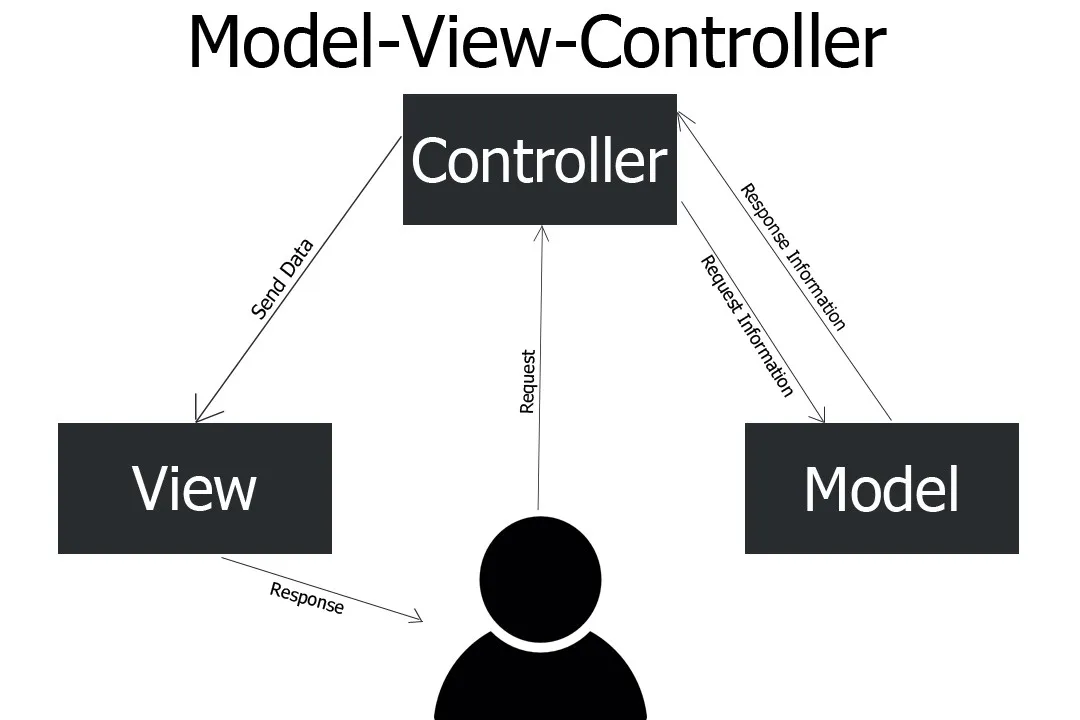
My second goal was about learning the programming language Ruby, and the web framework Ruby on Rails. I'm gonna be honest and say when learning Rails I thought it was a bunch of 🎩🔮✨magic. There were a bunch of built in helpers and hidden functionality that in the long run is super helpful and cuts down on boilerplate, but when learning can make things super confusing! Ruby on the other hand I enjoy a lot and in my mind is a more rigid JavaScript. I like my scripty languages. Minus the magic, Rails also introduced the Model, View, Controller (MVC) pattern to me. I have never used anything that followed this model that strictly, but it is pretty cool. First you have your Model which is the Data Model in your Database. This determines what Objects or Data Structures are and what they look like. Next you have your controllers that house all of your routes and business logic. Lastly is the view which allows you to render your data and pages to the user! At Shopify we are mostly building our new pages in React/TypeScript, but I still had to do a decent amount of work on our Rails pages. I also needed to build out some back-end logic like our GraphQL resolvers, so it was well worth learning Ruby. I have been exposed to enough different languages and frameworks over the course of my co-ops that I think I can pick things up fairly quickly and know enough to make an impact, but I definitely want more time to master the language/framework. Overall I would call Goal #2 a success!
My last goal relates to learning more about ecommerce and what it takes to create a business. I usually have very specific technical or technically oriented goals for myself on co-ops, but I am getting more interested in the business side of things, and thought this would be the perfect placement to learn more. I initially thought it might just include creating a Shopify store and going from there, but little did I know how much work and planning actually went behind creating a business. I first had to come up with an idea (which I think is actually one of the hardest parts!) and then decide on how my business was going to operate. I actually decided to move forward with the initial shop idea I had when creating my onboarding Shopify store, because I thought it was neat 🤷♂️. The product I came up with was selling different programming language logos and frameworks on different types of clothing, and ideally appealing to developers, product people, and passionate techies who want to rep their favourite swag. As a part of this venture, I had to create the initial products by using a third party to create the designs, purchase some base inventory, design and add the products to my Shopify store, and finally market and get the word out. Some interesting things I had to look into was that I had to first make sure I could actually use and sell these logos. From my research it was fine as most of the logos are under a free to use or creative commons license. I then had to figure out the best way to market my shop through Facebook/Instagram ads and select my target demographic, as I want to eventually make this profitable. Shopify graciously covered my base inventory of a few sweatshirts and the first week of advertising was enough to get the ball rolling. I hope to make this even better and more successful soon enough! I not only got to learn more about the inner workings of a business, but I was also able to empathize with our Merchants and experience what they go through each and every day. As easy and seamless as our platform is, you still need to put the work in! My store is Software Swag
Job Description
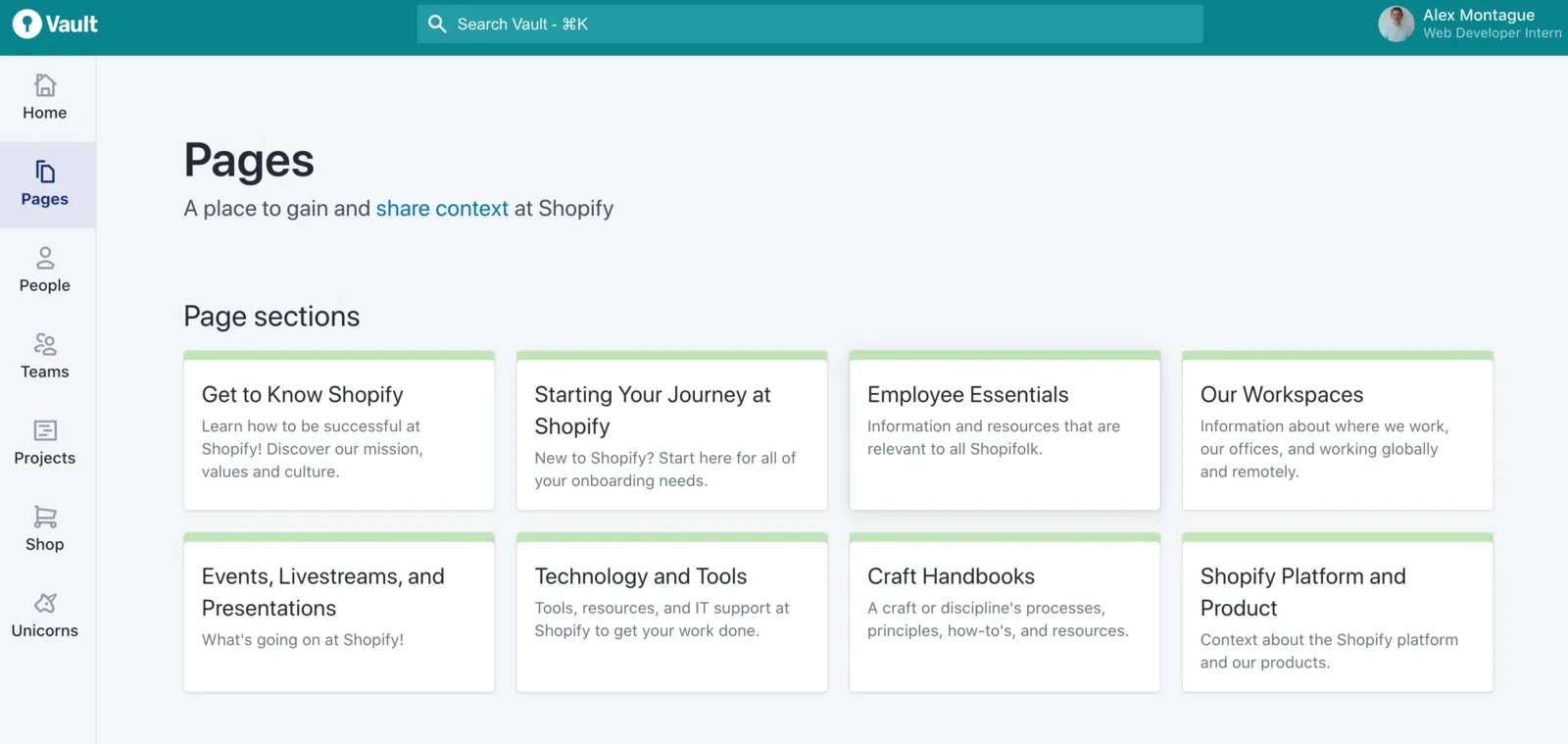
I joined Shopify as an Intern Web Developer and that was pretty true to what I was doing! Lots of code, lots of web development. My team is usually working in the Partners repository where we maintain the Partners dashboard which is where (you guessed it) all of our Partners check in on their Stores, Apps, Themes and other Statistics. This is the heart of the Shopify Ecosystem, and where we allow lots of other developers to collaborate and hopefully have success in creating things for other Merchants to use. I really enjoy being a fullstack developer, as I believe this gives you a broad understanding of the codebase and really helps when developing features. I find this gives you the most context and easily allows you to understand how most things work, and this was very much what I was doing, as I was touching all sides of our codebase! My day to day usually consisted of a standup where the team coordinated on what we were doing for the day and if there were any blockers, meetings if there were any, and development! Our team was responsible for 2 main areas of work over the course of my placement, which were App Management and API Versioning. The App Management side dealt with our App portion of the dashboard, which is where partners would see the status of their developed apps and allow them to easily configure them. The Versioning side dealt with all the implications of deprecating and making sure Partners transitioned from old API versions, to new ones. I would do most of my work on the App Management side of things, but it was cool to learn about API Versioning as I never really thought about the implications of millions of consumers hitting the same API, and how you coordinate updates/changes to that API.
One thing that was interesting/unique about my job was probably learning about the Shopify Ecosystem and how that fit into our business model. I always knew Shopify as ecommerce and shops, but I didn't know anything about the Shopify App Store, Theme building or experts and their services. Regarding the apps side of things, it is super important as we develop the core Shopify functionality, but we also enable developers to create custom apps that interact with our service that ultimately makes our product better for Merchants, while also letting them generate revenue. It's a win-win!
Some of the skills that I needed to succeed at this job were obviously some prior web dev/JavaScript knowledge, but also a passion to learn. I already had practice with React which was definitely a plus, but using a strongly typed language like TypeScript was totally new, as well as learning some new technologies like Ruby/Rails and GraphQL. I really love to learn new things and want to do the very best I can at any job I’m placed in, so in my opinion a motivation to learn is one of the best skills you can have for any job. Software design classes had also prepared me for agile and scrum team environments, so I understood our practices and methodologies right off the bat!
Some skills that I gained during this placement were definitely in line with the goals I set for myself. I was able to get some experience around new tech that I wanted to learn more about, and even gain some valuable business knowledge. I find learning about new tech and being able to understand something fairly quickly is invaluable in this field, especially in web development. I appreciate all of the experience I have gotten over the years to aid in my learning. I attribute most of my success to the great resources I had available at my disposal, and the helpful nature of the team/company. I was able to go and ping pretty much any other developer when I had questions or concerns, and I was really able to influence what I wanted to work on. If I was interested in learning or getting more experience with something, I would usually get the opportunity to work on it!
Academic Relation
Relating this job back to my degree and studies, I feel both positively impact each other and enhance my learning greatly. There were some experiences and concepts I had learned before this placement that positively affected my work experience, and what I have learned from this placement will also allow me to further succeed in my last school terms + working Full Time. Shopify was a fantastic co-op placement and I have learned a lot that I will take with me throughout my career. I would also like to highlight the importance of relationships, and how that may be one thing that gets missed when talking about the academic portion. I had always heard about Shopify and the great things coming from them, but without talking to a few other students that had done internships here, I would not have known how awesome of an experience it really was. Through my past co-op placements I was put in contact with some students I met at League (The company Shopify uses for benefits - check it out!), and they told me some really great things about Shopify. I think it's valuable to not only be a great developer as a co-op, but also be a social and good person to stay connected with. You never know when the connections you have made might help you out later!
Featured Aspect
One aspect of this work term that I would like to focus on and talk a little bit more about is GraphQL. Even though I already touched on it a bit in the goals section, I thought this was hella cool and I will be considering using this over REST for the foreseeable future. This was the first time I have ever used this technology, but it will not be the last as I think this is an immensely useful tool. GraphQL is a query language for APIs and a runtime for fulfilling those queries with your existing data. GraphQL provides a complete and understandable description of the data in your API, gives clients the power to ask for exactly what they need and nothing more, makes it easier to evolve APIs over time, and enables powerful developer tools.
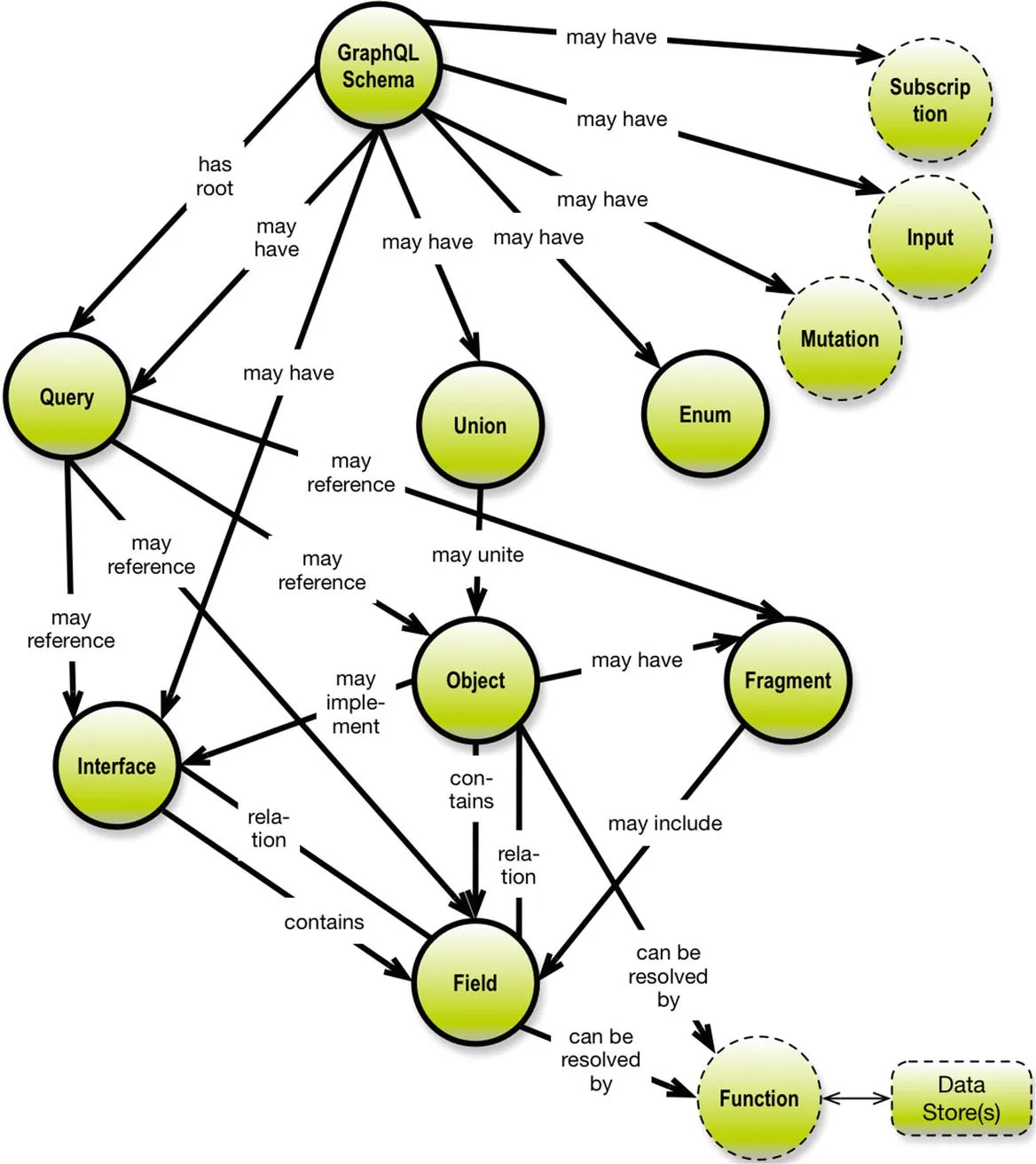
To give the quick overview before you play around with GraphQL, GQL is not some magical data fetcher. There are two main parts to every GQL server that determine how it works. The GQL schema, and the resolvers. Your schema will basically determine the shape of the data. It defines what queries clients are allowed to make, what types of data can be fetched from the server, and what the relationships between these types are. A GQL schema could look like this:
type Author {
  id: Int
  name: String
  dateOfBirth: String
  books: [Book]
}

type Book {
  id: Int
  title: String
  ISBN: String
  author: Author
}

type Query {
  getAuthor(id: Int): Author
  getBooks(titleContains: String): [Book]
}

schema {
  query: Query
}
The schema is super simple, and consists of 3 types. The last type, Query, is just to mark the entry point into the schema. This schema also aligns with our example from earlier, so you can use this as a good reference. As you can also tell, these types reference each other. This schema just defines what shape the data is, and what relationships (in our 'graph') are allowed to be defined.
So this is great, but how do we actually get the data now? This is where resolvers come in. Resolver functions are like little routers. They specify how the types and fields in the schema are connected to various backends, answering the questions “How do I get the data for Authors?” and “Which backend do I need to call with what arguments to get the data for Books?”.
GraphQL resolve functions can contain arbitrary code, which means a GraphQL server can talk to any kind of backend. For example, the Author type could be stored in a SQL database, while Books are stored in MongoDB, or even handled by a microservice. Perhaps the greatest feature of GraphQL is that it hides all of the backend complexity from clients. No matter how many backends your app uses, all the client will see is a single GraphQL endpoint with a simple, self-documenting API for your application.
This could be an example of our 2 resolver functions:
getAuthor(_, args){
  return sql.raw('SELECT * FROM authors WHERE id = %s', args.id);
}

getBooks(author){
  return request(`https://api.book.io/by_author/${author.id}`);
}
As you can see, we get our data from 2 very different sources, but the end user won't know that. You also usually won't be writing raw SQL in the resolver function and will keep that in a separate module, but you get the point. From my experience, writing your resolver functions is definitely the most challenging part, but it gets easier with practice!
Play around with this example GraphiQL interface! It uses the same schemas defined in the examples. Try copying, pasting and running the below query!
query getBooks{
  getBooks {
    id
    title
    isbn
    authorID
  }
}
Hopefully you get the feel of GQL, and can see how powerful this framework really is!
Conclusion
Shopify has been an absolutely amazing placement and I could not have asked for more. I will take the experiences and skills I have gained here throughout my career. The work I was able to achieve over these 4 months was exciting, challenging and rewarding, not to mention the people I was able to interact with were also awesome. Not one person I asked for help would turn me away, and everyone always wanted to see me succeed. I was genuinely surprised to see the part of Shopify I would be working on when I joined, as I literally didn't even know we had an entire ecosystem that has such a big impact on our company and partners. It was super cool, and I learned so much. Some companies that use our product every day are huge, so I really enjoyed building a service that some seriously influential companies utilize every day. Not just the giants though, seeing how we can help smaller partners be successful is just as, if not more rewarding. A big thank you goes out to some special people who made this term fantastic. Mike for being a great manager and for taking me on the team, Theo + Thomas for being some super cool mentors and teaching me some kick-ass stuff, and the entire app-management team for being so welcoming, appreciating me, and just being awesome. Thanks again to everyone at Shopify, it has been really fun. I'll see everyone again in 2021! :)
Extras
As mentioned, I have a few extra things to share including one of the features I worked on and how the global pandemic affected this co-op term.
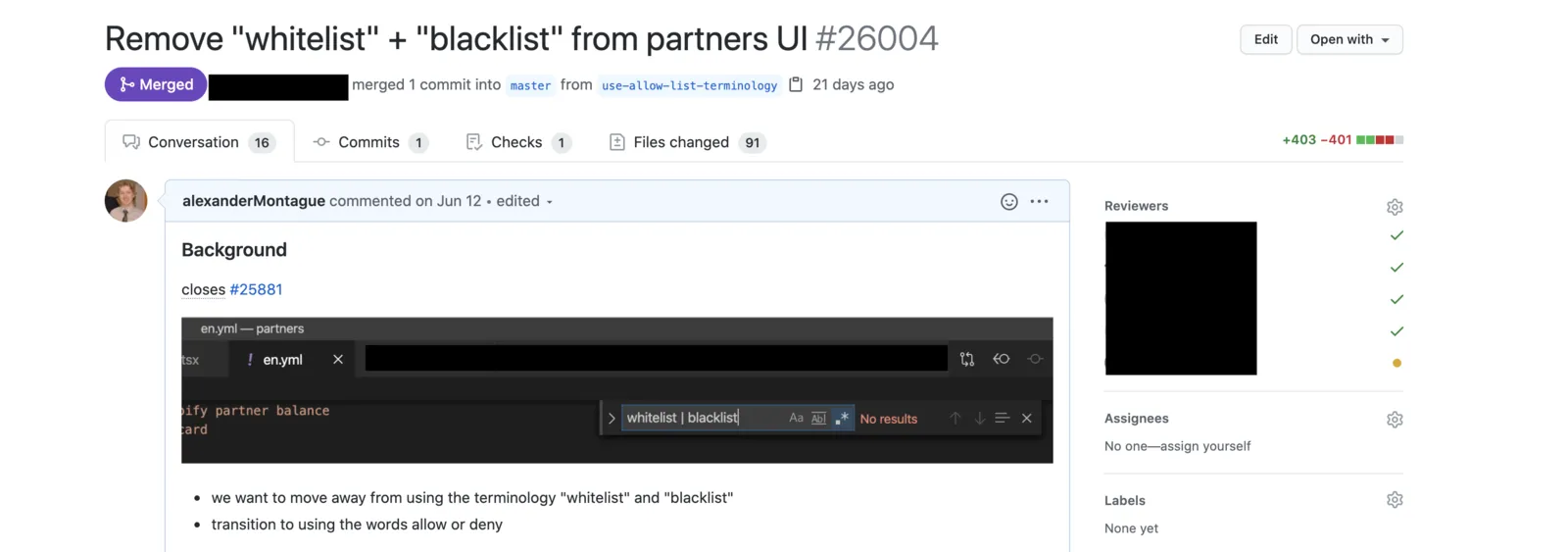
This task came up after our initiative to make Shopify a more welcoming and diverse company. I'm all for that, and what better way to start than by not only removing some dated language from our UI, but also our code. When I first saw this ticket on our board, I thought it wouldn't be too hard at all. A quick find + replace, rename some files, maybe fix a test or two and we're good! Boy was I wrong. What I failed to realize was that we had some DB columns containing this language, so after renaming everything, things broke 🛑. My first fix was to try and rename everything but the underlying connecting code that ultimately referenced the columns. This led to a very confusing debugging process where some values were getting passed, but I missed a few others because of the massive amount of occurrences. I ended up with removing about 95% of the references, but still have the DB connecting code to fix, as that requires migrations and a lot more work. Overall, it was a good challenge that let me explore our Ruby code more, I removed this language from our UI and most of our code, and I contributed to making Shopify a better and more welcoming place for our Partners, and our Developers!
Working At Home - COVID-19
If you want to read about my experiences working at a Digital by Default company and fully remote, check out this blog I wrote!