
Introduction
Welcome to my second work term report! This placement has been an unreal experience and I have had a lot of fun, while meeting and working with a lot of great people. Throughout this report I will talk about the company I had my placement with, some goals I set for myself, and what the overall experience was like. I hope you enjoy, and for any other information feel free to contact me!
Employer Information
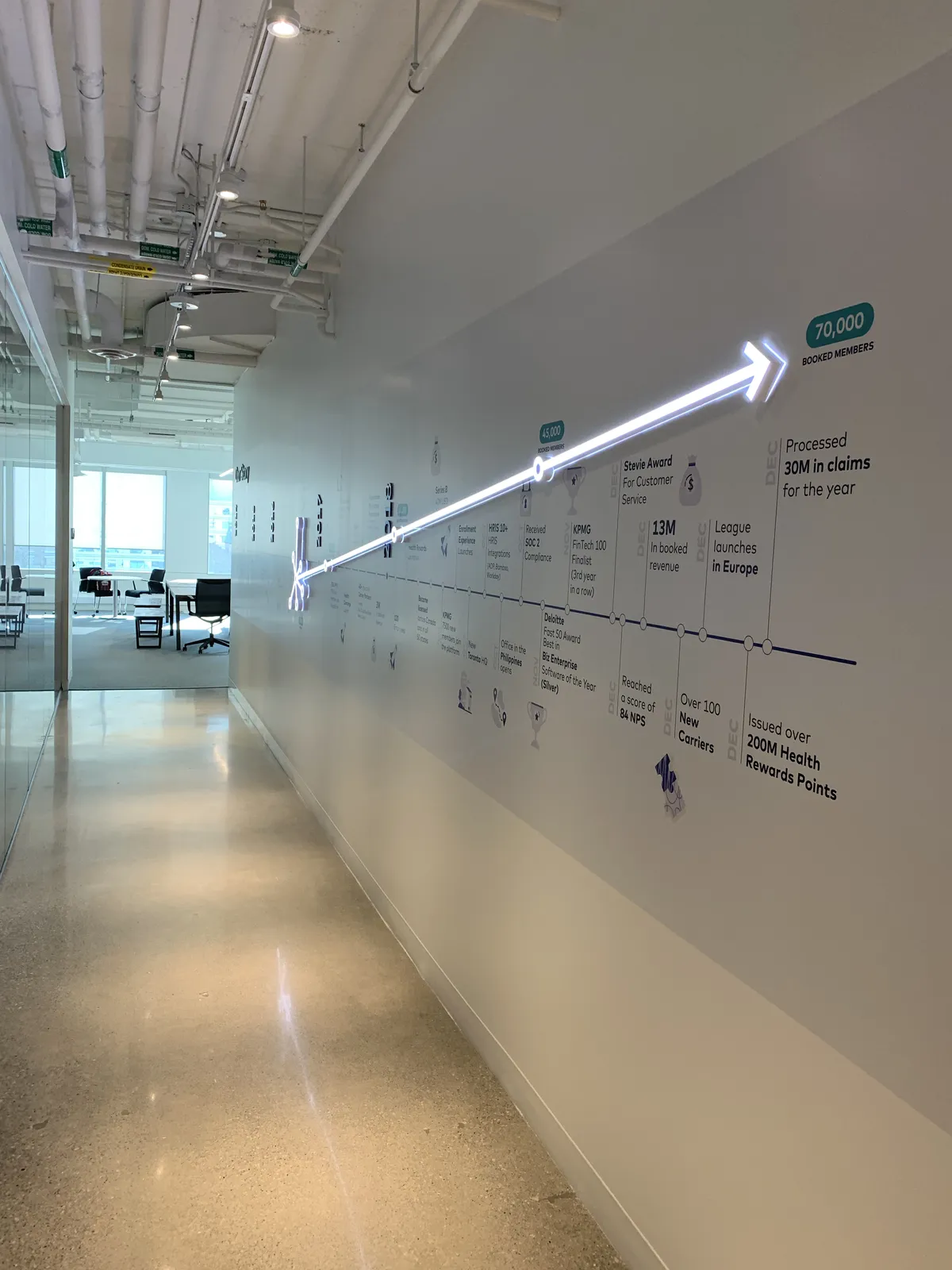
For my second placement I was able to work at another Toronto based start-up called League Inc for a wonderful 4-month term. League is transforming the way people use and interact with their benefits through League’s intuitive platform. League is aiming to create the best and healthiest platform to select, manage and interact with your employer provided benefits. This was a super cool experience as I never had previous exposure to benefits or any health-related sectors, so this was a great opportunity. League was founded in 2014 by serial entrepreneur Mike Serbinis along with COO Dan Leibu and CTO Dan Galperin. The trio previously worked together on Serbinis’ other venture Kobo, where they later left to start League. League truly is all about creating a healthier future, and that is really reflected in their values and culture. Whether it is League’s in-house yoga to healthy snacks in the kitchen, I really enjoyed learning and working inside such a positive company. I was located in the Toronto office as a Full Stack Developer on the Integrations Team, but League also has offices in Chicago, and the Philippines!
Goals
For this placement I created 3 goals for myself to hopefully achieve by the end of this placement. Two goals revolved around our tech stack as that was what I was really interested in learning, but I also left an open-ended goal pertaining to improving a current process at League. I was uncertain of how exactly these goals would play out, but I was motivated and committed to learn, grow and work my hardest to achieve them!
- Create, PR, and Deploy my first “real” frontend ticket into the League frontend repository
- Write, Test, and Merge first Golang feature into the League services repository
- Identify some current process at League that could be made better, and ultimately execute a plan to make that process better than it was before
I was happy to report that at the end of the term I successfully accomplished all of my set goals. The first two goals eventually came with time and more exposure to the codebase, where the third goal was definitely the most difficult to fulfil. For the first goal I was able to develop and ship my first “real” frontend feature within the first two weeks. My definition of “real” was not just copy pasting existing code, but actually coming up with a solution and implementation from scratch. I was lucky enough to have prior knowledge and experience with production level React/Redux, so this was not too difficult to implement. It was interesting to see how League’s React conventions differed from my last company, and that took some time to get used to but was also welcomed. For my second goal, this was something I was very eager to achieve. I have never written a single line of Go before my time at League, and honestly did not even know what type of language it was, or how it worked. The first few weeks were just spent learning the language and its quirks, but within the first month I was able to ship my first piece of Golang code. It was by no means anything special, but it was a fantastic learning experience and great introduction to the language. My last goal was difficult to implement as I had no idea what process I would be improving on. As my time at League progressed I recognized a possible pain point and eventually settled on an improvement I felt was not only important, but also relevant to the team I was on. The process I saw was in the way we integrated employers onto our platform through an integration framework. We did this by basically writing recipes that contained logic to onboard, update and modify employees, but these recipes could get pretty long and intricate. I found a way to run the process of creating and updating these recipes through our GitHub repository, so we had a formalized review process set in place and a way to keep track of all of our changes through Git! I will talk about this a little bit more in the Extras section if you are interested in learning more.

Job Description
For this placement at League I joined the team as a Fullstack Developer on the Integrations team. I was excited to have the “Fullstack” responsibility as I was able to get Frontend experience at my last co-op, but only backend experience through my side projects. I was looking forward to working with some production level backend code, especially with a language I was unfamiliar with! On the integrations team we were tasked with integrating into employers’ Human Resources Information Systems (like BambooHR or ADP) and using that data to onboard employees onto our platform. This works for us as it requires minimal effort on the employers’ side and provides us with up to date and valid information. Our day to day duties consist of implementing features directly relating to the integration of employees, and includes crafting integration recipes, invoicing, reporting, and extending API capabilities. I personally got to work on some awesome features like E2E integration recipes, invoice redesigns, new admin tool functionality and some HR API updates along with a bunch of bug fixes! Overall the range of available tasks grew with my time and exposure to League’s product, and I was happy to learn and work on everything I touched!
One thing that was interesting/unique about my job was that I was directly involved with the integration process, and how it was such an important portion of our business. I was responsible for a lot of key components and it was an awesome experience to learn from. Being around the benefits space and learning more about how benefits actually worked was super cool as well. I can take that real-life knowledge with me throughout my career!
Some of the skills that I needed for this job were definitely some computer science basics, but also a passion to learn. I came in with some prior knowledge of our Frontend stack and MongoDB which was definitely a plus, but as for the rest of our Backend stack this was completely new to me. I really love to learn new things and want to do the very best I can at any job I’m placed in, so a motivation to learn is the best skill you can have for any job, including this one. Software design classes had also prepared me for agile and scrum team environments, so I understood our practices and methodologies almost right off the bat! Some skills that I learned while on the job were developing clean and concise Go code, as well as some higher-level platform and architecture things. When you are involved heavily in the backend, you also start to learn why and how we set our architecture up in the way we did.
Academic Relation
Relating this job back to my degree and studies, I feel both positively impact each other and enhance my learning greatly. There were some experiences and concepts I had learned before this placement that positively affected my work experience, and what I have learned from this placement will also allow me to further succeed in my next school term. League was a fantastic co-op placement and League’s established student program was also so useful to go through. Getting to meet other current co-ops and engineers that were previously co-ops was super neat as I got to see how they progressed through their careers. This insight alone was invaluable, and I met some amazing people that gave me some amazing advice. I think the degree in itself is definitely important, but the experience is really what shapes and grows the student. After only 2 placements I can say the real-world knowledge I have gained throughout them has been exponentially more relevant than what we learn in school. School teaches you “how to learn” and work lets you put those learning skills to use.
Featured Aspect
One aspect of this work term that I would like to focus on and talk a little bit more about is how Golang works and what it looks like! Go was super new to me and coming from an “anything goes” language like JavaScript, this was quite the change. But a good change it was! I fell in love with the strict + static typing and how definite things were. The syntax was pretty similar to C which I am also pretty familiar with, so it was not too bad to pick up at all. Go is like a nicer, garbage collected and concurrent C! Let’s see what a function that would add two numbers together and return the sum looks like in JavaScript, and then in Go.
// JS
function addNums(x, y) {
  return x + y;
}
// Go
func addNums(x, y int) int {
return x + y
}As you can see, Go defines the type of its arguments, and its return type. This does not just apply to functions and methods though, everything is statically typed when you define it! This was frustrating at first, but super helpful when using a smart IDE like GoLand. It will show type errors before you even compile and lets you click through to type definitions, which was immensely helpful. Let’s go back to our code example and see why I love strong types:
// JS
function addNums(x, y) {
  return x + y;
}

let returnNum = addNums("uh oh!", 5);
console.log(returnNum);  // uh oh!5
typeof returnNum;        // string
// Go
func addNums(x, y int) int {
return x + y
}
var returnNum = addNums("uh oh!", 5)
// cannot use "uh oh!" (type string) as type int in argument to addNumsAs we can see, Go shuts this down pretty quick, whereas this is perfectly legal in JavaScript. Obviously there are some checks we can do in JS to prevent things like this from happening, but a type system prevents all this!
One thing that I also really liked was that Go has built in functionality and tooling. Go has a standard code format that everyone must abide by (called Gofmt), which makes PR notes about code styling irrelevant. Most people now use a JS library like prettier to format their code for the same reason, but it was cool to see that Go’s was internal and out of the box. One thing I also liked was that Go has an internal testing framework for unit tests. This also eliminates the need to search for multiple testing frameworks as this is a standard. There is also just something satisfying about creating components you know will never change, and if they do, you catch the problem right away! I can’t tell you how many problems and bugs I have had due to weak and dynamic typing causing unexpected behaviour. Take a look at this example of ingesting JSON.
// JS
const response = `  // mock JSON
  {
    "sex": "male",
    "eyeColour": "blue",
    "age": 21,
    "location": {
      "province": "Ontario",
      "city": "Toronto",
      "address": "123 Street W."
    }
  }
`

const newPerson = JSON.parse(response);  // parse/fetch data
// What is the newPerson structure without knowing?
// Extra data included in request would be passed along

// If address was not present, this would error out
console.log(newPerson.location.address)

// We should always explicitly state when we want to deal with numbers in JS
console.log(Number(newPerson.age))
// Go
response := ` // typing can be inferred!
{
"sex": "male",
"eyeColour": "blue",
"age": 21,
"location": {
"province": "Ontario",
"city": "Toronto",
"address": "123 Street W."
}
}`
// use JSON tags to specify field names!
type Person struct {
Sex string `json:"sex"`
EyeColour string `json:"eyeColour"`
Age int `json:"age"`
Location map[string]string `json:"location"`
}
var newPerson Person
json.Unmarshal([]byte(response), &newPerson) // parse data
// We know exactly what is going to be in newPerson
// We have confidence this is present and will not error unexpectedly
fmt.Println(newPerson.Location["address"])
// We know this is an integer!
fmt.Println(newPerson.Age)You really have no idea what your response is going to look like in JS but Go code self-documents. I really enjoyed that aspect and very rarely did I have to print something to stdout to see what the structure is going to look like, whereas debugging my JS usually involves a lot of console.log’s. Because of working with Golang this term, I have decided to switch to TypeScript for all of my future web projects, as I cannot live without typing anymore!
Conclusion
League has been an unreal experience and I could not have asked for a better placement. The work I was able to achieve over these 4 months was exciting, challenging and rewarding. I have learned so much as both a person, and developer, I will take what I have experienced this term throughout my career! Not to mention the work I was doing, but the people I was able to interact with were awesome. Not one person I asked for help would turn me away, and everyone always wanted to see me succeed, no matter what. The mentorship provided to me throughout this placement was remarkable. Now I would just like to thank some people who have made this placement unforgettable. Daniel for being my league mate and a great knowledge base, Damien for being an amazing manager and leader, Anne for running a fantastic student program and Connor for ultimately giving me this opportunity! Thanks to everyone at League who made this term really great. I hope to be back one day!
Extras
As mentioned, I have a few extra things to share here regarding my term at League. I would like to talk a little bit more about my custom League Integration Tool, as well as share a blog post written about League’s engineering co-ops!
League Integration Tool
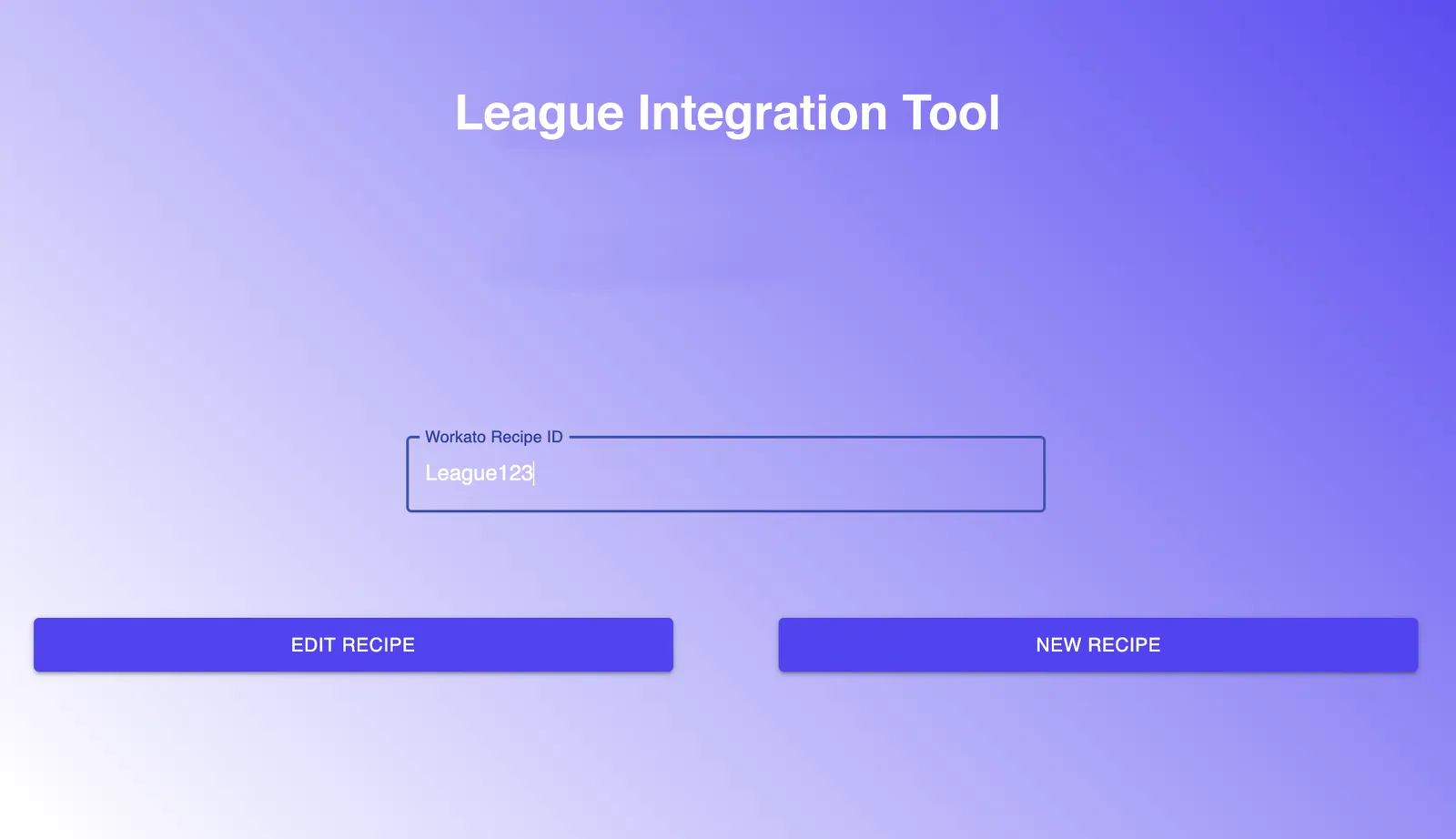
This tool was created as an attempt to improve our current integration recipe creation and update process. As a quick recap, we at League used an integration service that required integration recipes to be written containing logic regarding how the integration flow would go. We would write these recipes, save them and let the integrations run continuously. We tested them the best we could within the framework’s capabilities, but there was still room for error. I wanted all of our recipe creation and updates to go through a formal review process that would at least add one more step between the development and deploy state. Above all else we would also be able to capture everything in Git to use as a backup/rollback, or to see exactly who made changes when. My proposed solution to this would be to use a custom tool that wrapped all of the backup and review process in an easy to use and intuitive platform. Here is what the tool looked like: … The tool was built using Electron and React/Redux, as well as utilizing isomorphic-git and GitHub’s + Integration platform’s APIs under the hood. As a recipe developer, you have two flows to go down. The edit recipe will allow you to edit a current recipe running in production. Once the ID of the recipe you wish to edit is entered, the tool will clone the current running recipe and switch all connectors over to our test environment. The recipe will be developed and tested, and then once the developer is confident in the recipe, they will ask for a review from the tool. The tool creates a PR to our repository and awaits a review. Once the recipe has been approved, you can go ahead and merge the recipe from the tool. After requesting the merge from the tool, the PR gets merged into the repo, and the dev recipe with all of the new changes will seamlessly get merged back into the currently running parent recipe. The same goes for the new recipe flow, except the recipe is created and tested, but then once the review passes the recipe is only added to git, as the recipe was already created on our integration platform. There was still lots of work to do when I left, but hopefully it was a step in the right direction!
League Engineering Co-ops
One other amazing thing that I got to participate in while at League was the League Student Program. This program set us up to meet some amazing people in League, learn how to grow our careers, make some awesome connections and ultimately get more out of our placement. You can learn some more about the student program and the other engineering co-ops by checking out this article!